

No crust, no water bath, deliberately scorched on top — this cheesecake breaks nearly every rule the standard version follows, and that’s the whole point. It started at La Viña bar in San Sebastián, and the genuinely burnt top (not golden, not caramel-colored — close to black in spots) is intentional, not a mistake to fix next time.
What you get underneath is a custardy, almost molten center, miles softer than a New York-style cheesecake, held together by nothing but eggs and cream.
Ingredients and why each one matters
- 24 oz full-fat cream cheese — room temperature, not straight from the fridge, or it won’t smooth out without lumps
- 1 cup granulated sugar — sweetens and is part of what caramelizes on top
- 3 tbsp all-purpose flour — just enough structure to keep the cake from collapsing entirely once it’s cut
- 1/2 tsp salt
- 1/2 tsp vanilla extract
- 4 large eggs, room temperature — they’re doing most of the structural work here, with no flour-heavy base to fall back on
- 1 1/4 cups heavy cream — this is what makes the center custardy rather than dense
Everything at room temperature isn’t a suggestion here — cold cream cheese straight into the mixer is the single most common reason people end up with a lumpy batter and blame the recipe.
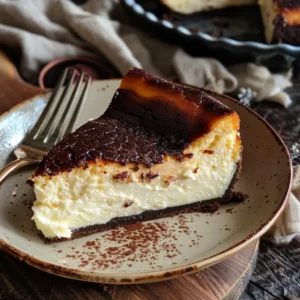
Burnt Basque Cheesecake

Ingredients
- 24 oz full-fat cream cheese softened
- 1 cup granulated sugar
- 3 tbsp all-purpose flour
- 1/2 tsp fine salt
- 1/2 tsp vanilla extract
- 4 large eggs room temperature
- 1 1/4 cups heavy cream
- butter and parchment paper for lining the pan
Instructions
- Preheat the oven to 400°F (200°C). Grease a 9-inch pan and line it with two overlapping sheets of parchment.
- Mix the cream cheese, sugar, flour and salt until smooth.
- Add the vanilla, then the eggs one at a time, mixing gently.
- Stir in the heavy cream until fully incorporated.
- Pour the batter into the pan and tap it to release air bubbles.
- Bake for 50 minutes at 400°F, then increase to 425°F (220°C) for the final 10 minutes. The top should be very dark and the center should wobble.
- Cool at room temperature for 45 minutes, then chill for at least 4 hours or overnight.
- Slice with a warm knife and serve chilled or at room temperature.
Notes
- Use room-temperature ingredients for a smooth batter.
- Don't overmix: extra air causes cracking.
- The burnt top is intentional and adds a caramel flavor.
- Keeps 5 days in the fridge or 2 months in the freezer.
Getting the bake right
Line a 9-inch pan with two overlapping sheets of parchment that extend a couple inches past the rim — this is what gives the finished cake those signature crumpled, overhanging edges, and it’s also how you’ll lift it out later without a springform pan.
Beat the cream cheese, sugar, flour and salt until completely smooth before adding anything else. Add the vanilla, then the eggs one at a time, mixing only until each is incorporated — stop there. Stir in the heavy cream last, just until the batter turns silky and uniform.
Pour into the pan and tap it on the counter a few times to knock out air bubbles; trapped air is what causes uneven cracking later. Bake at 400°F for 50 minutes, then bump the oven to 425°F for a final 10 minutes — the top should go properly dark, bordering on black in places, and the center should still wobble like a loose gelatin when you nudge the pan. That wobble is correct, not underdone.
Cool at room temperature for 45 minutes, then refrigerate at least 4 hours, ideally overnight. A warm knife, wiped clean between cuts, gives the neatest slices.

Why it cracks (and why that’s fine)
Cracks on top are part of the style, not a failure — they come from the cake expanding rapidly in the hot oven and then contracting as it cools, which a crustless, flour-light batter can’t fully resist. Overmixing after the eggs go in makes cracking worse by whipping extra air into the batter, so the main thing you can actually control is mixing gently from that point on.
Storage
Keeps covered in the fridge for up to 5 days — if anything, the flavor gets better after a day as it settles. It also freezes well for up to 2 months; thaw it overnight in the fridge rather than on the counter.
If you want something in a similar rich-and-creamy register but without turning on the oven, the strawberry crunch cheesecake is fridge-set start to finish.